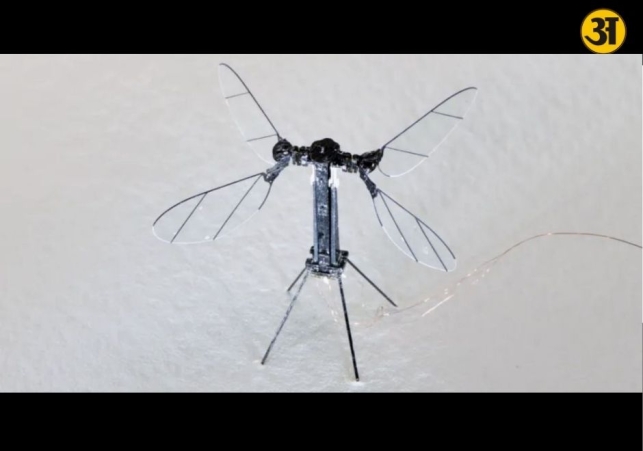
Tiny drones could transform spying and military operations
China develops mosquito-sized drones that may change future warfare
China is making a big step in military technology with the development of mosquito-sized drones. These very small flying machines could change the way wars are fought in the future. The drones are designed for secret missions, spying, and gathering important information without being noticed.
The drones were developed by China’s National University of Defence Technology (NUDT) in Hunan province. The project was recently shown on CCTV 7, China’s military television channel. The report showed different robotic machines, including human-like robots and very small drones. Among them, the mosquito-sized drone attracted the most attention because of its tiny size and powerful use.
The drone looks almost like a real mosquito. It has a thin body, tiny wings, and very small legs. Its size is so small that it can be held between two fingers. This makes it almost impossible to notice from far away. Because of this, experts believe it can be very useful in military missions.
Built for secret missions
According to the researchers, the tiny drone is mainly made for battlefield reconnaissance. This means it can quietly enter dangerous places, collect information, and send it back without being seen. In war, information is very important. Knowing where the enemy is, what weapons they have, and what they are planning can decide the result of a battle.
This tiny drone can enter small spaces where normal drones cannot go. It can fly inside buildings, tunnels, forests, or crowded areas. Since it is so small, enemy radar systems may not detect it easily.
The drone can also be used for special covert operations. These are secret missions where soldiers need to stay hidden. For example, the drone can be used to spy on enemy camps, track movement, or listen to conversations.
China’s researchers also showed another small drone model with four wings. This version can be controlled through a smartphone. This means soldiers may not need heavy control systems to use it. A simple phone can guide the drone.
Making such a tiny drone is not easy. Engineers had to fit many important parts inside a very small body. These include sensors, batteries, cameras, communication systems, and control circuits. All these parts need to work together perfectly for the drone to fly and collect data.
Experts say this kind of technology needs knowledge from many fields like robotics, materials science, and micro-engineering. It also uses ideas from nature, especially insects, to copy their flying style.
The movement of a mosquito is very smooth and fast. Scientists are trying to copy this natural design so that the drone can move in a similar way. This makes it harder to spot.
ALSO READ: Growing vascular disease may be hiding behind common leg pain
ALSO READ: UK defence secretary quits over military funding dispute with Starmer
A growing race in micro-drone technology
China is not the only country working on small drones. Many countries are developing similar technology.
One famous example is the Black Hornet 4. It is made by Teledyne FLIR Defence. This drone is slightly bigger than China’s mosquito drone but is still very small. It is already being used by many armies around the world. It helps soldiers see enemy positions and danger areas.
The Black Hornet can send live video to soldiers using a small handheld device. This gives soldiers important information in real time.
In the United States, Harvard University has also been working on a small flying robot called RoboBee. This robot is inspired by bees. It can fly, swim underwater, and even land on surfaces using static electricity.
This shows that many countries see great value in tiny drones.
These small drones are not only useful for the military. Scientists believe they can also help in many civilian fields.
In medicine, tiny robots may one day be used inside the human body. They could deliver medicines directly to affected areas, perform small surgeries, or help doctors in scanning organs.
In farming, these drones can check crops, monitor plant health, and detect diseases early.
In environmental work, they can study pollution, monitor wildlife, and inspect dangerous areas where humans cannot go.
However, the rise of such drones also raises serious concerns.
Privacy is one of the biggest worries. Since these drones are so small and hard to see, they could be used to secretly record people without permission.
Security experts also warn that criminals or hackers may misuse this technology.
There are also ethical questions. If these drones become armed or fully automatic, it could create new dangers in war.
Many experts believe governments around the world will need strong rules to control how such drones are used.
China’s mosquito-sized drone is a major example of how technology is changing modern warfare. In the past, armies depended on large machines like tanks, fighter jets, and big surveillance drones. Now, even something as small as an insect can become a powerful military tool.
These tiny drones may change the future of spying, intelligence gathering, and battlefield planning. Their ability to stay hidden while collecting important information gives them a strong advantage.
At the same time, this new technology brings new risks and challenges. As countries continue to improve these drones, the world may soon see a new era where the smallest machines play the biggest role in war and security.
Related News